
Pickens County Court Records After Arrest
In Pickens County, a jail arrest and a court case are related but not the same record. The Pickens County Detention Center roster is a custody record. It may show an arrest date, held-for-agency label, charge text, bond type, bond amount, magistrate or city judge name, and other-agency holds. Formal court records after a jail arrest are kept in the South Carolina court system through the Pickens Public Index, the Clerk of Court for General Sessions matters, Magistrate Court, Municipal Court, and the Thirteenth Judicial Circuit Solicitor.
The normal path is arrest, jail booking, first appearance or bond setting, then prosecution review. South Carolina calls the elected prosecutor a solicitor, not a district attorney. For Pickens County felony and serious criminal cases, the Pickens County Office of Solicitor is part of the Thirteenth Judicial Circuit. The solicitor may file charges that match the booking text, but the office can also amend, reduce, dismiss, or present charges for indictment. That is why a roster charge should be treated as a lead, not as the final court record.
Booking records, custody status, and row-level hold reasons belong on the jail side. For current custody details, use Pickens County jail inmate records. For booking photos and mugshot access, use Pickens County jail roster mugshots. Court records after arrest focus on filed charges, court events, warrants, bond decisions, and case outcomes.
Find Pickens County Arrest Court Records
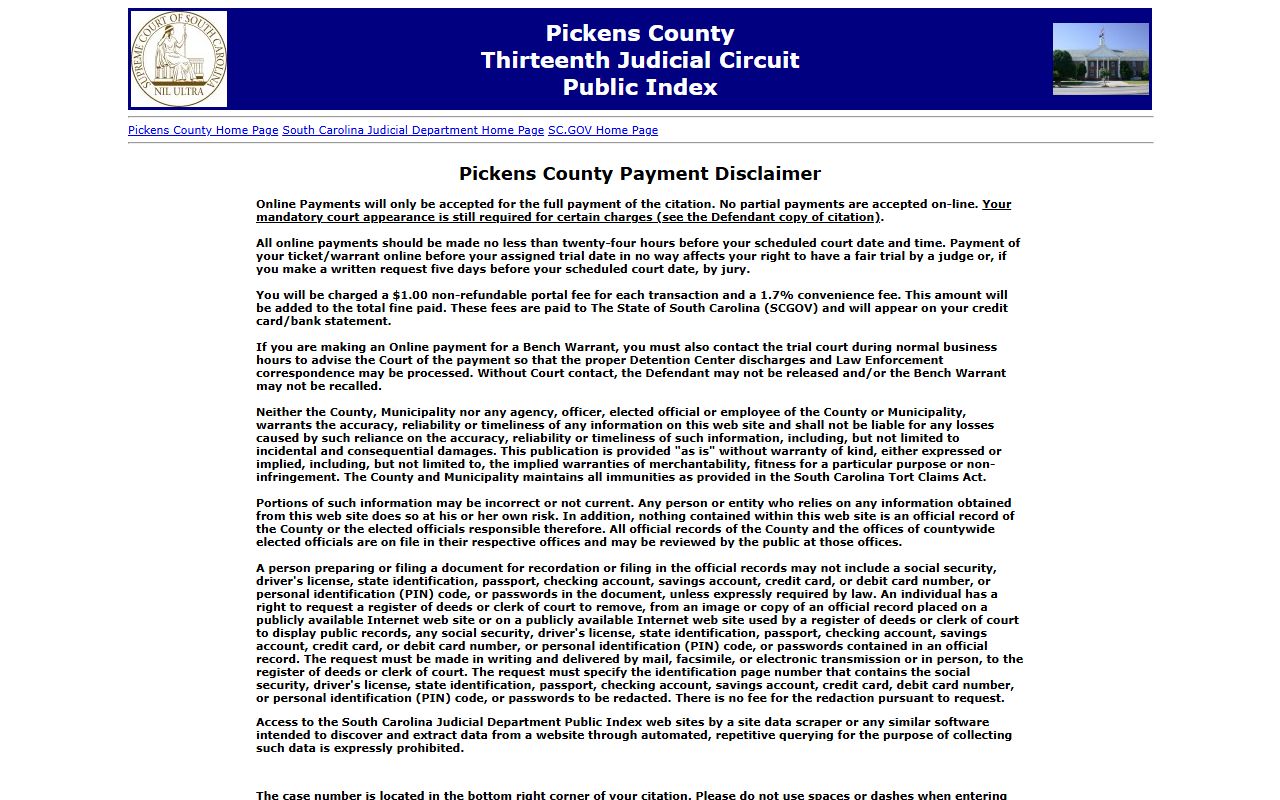
The main public court search channel is the Pickens Public Index. It is a South Carolina Judicial Branch case portal and may require JavaScript and cookies. The Judicial Branch also keeps a broader case records search landing page that links county indexes. If the online index gives only file information, the Clerk records request page is the route for copies of specific General Sessions, Common Pleas, or Family Court documents.
The official Pickens County Clerk records request page is important because it lists the identifiers the Clerk wants. Those identifiers help connect a jail arrest to the court records that follow. The Clerk states that it maintains Common Pleas, Family Court, and General Sessions documents, but it does not retain Magistrate Court records, Municipal Court records, or State Grand Jury records. Agency-specific documents, such as incident reports or booking materials, must be requested from the agency that has them.
| Identifier | Where It Helps | How to Use It |
|---|---|---|
| Case number | Public Index and Clerk requests | Use it when known for the most exact court-record match. |
| Arrest warrant or ticket number | Magistrate, municipal, and Clerk routing | Start here when the jail roster or citation gives a warrant or ticket reference. |
| Indictment number | General Sessions cases | Use it for circuit criminal matters after grand jury action. |
| Party or defendant name | Search fallback | Search by name when no number is available, then narrow by court level and date. |
| Specific documents requested | Clerk copies | Name the warrant, indictment, sentencing sheet, disposition, order, or other record. |
The Pickens Public Index screenshot in the project source set shows the court portal used for Pickens County case lookup.
From Jail Arrest to Case
A Pickens County arrest often starts with the Sheriff's Office, a municipal police department, Clemson University Police, South Carolina Highway Patrol, SLED, SCDNR, the State Grand Jury, or another agency. The Detention Center can hold a person when it receives the required custody order. During intake, the jail record may be entered into the Zuercher roster with the name, arrest date, held-for-agency field, mugshot if published, and hold reasons. That still does not make the booking row the full court file.
- Save the name spelling, arrest date, held-for-agency label, charge text, bond entry, and any judge or magistrate listed on the custody record.
- Search the Pickens Public Index by defendant name, then narrow by case number, indictment number, warrant number, ticket number, or court level if known.
- Check whether the matter belongs in Magistrate Court, Municipal Court, or General Sessions. A city bench warrant may not route the same way as a felony charge.
- Use the Clerk records request process for General Sessions documents that do not appear online.
- Use the originating law-enforcement agency for incident reports, probable-cause materials, booking records, or agency files not held by the Clerk.
That workflow also helps when a person was booked on a warrant. The jail row may show a bench warrant or hold, while the court record shows why the warrant was issued and what happened after the person appeared in court.
Pickens County Charging Records
Charges after a jail arrest can enter the court record through more than one type of charging document. The exact document depends on the offense, the court level, and prosecution decisions. In General Sessions, the solicitor prosecutes felony and serious criminal cases and may move a matter forward through an indictment. Lower-level or early-stage matters may begin with a warrant, ticket, complaint, or related court filing before transfer or disposition.
| Document Type | Who Usually Drives It | What It Means in the Court Record |
|---|---|---|
| Complaint | Law enforcement or prosecutor | An accusation or starting paper tied to an arrest, warrant, citation, or lower-court case. |
| Information | Prosecutor | A prosecutor-filed charge document used when the state proceeds without relying on the initial booking text alone. |
| Indictment | Grand jury and solicitor | A formal General Sessions charging document for serious criminal cases after grand jury action. |
A charging document can differ from the charge label on the roster. The roster can show an arrest reason, a statutory code, a warrant text, or a bond line. The court file is where the formal charge, amended charge, disposition, sentencing record, or dismissal should be confirmed.
Pickens County Court Routing
Court routing matters because Pickens County has more than one place where criminal records may sit. General Sessions is the core circuit criminal court for felony and serious criminal cases, and those Clerk-maintained records are handled differently from Magistrate or Municipal Court files. The Clerk's own records page says Magistrate and Municipal Court records are not retained by the Clerk.
The Pickens County Magistrate Court page states that magistrates issue warrants, set bonds, hear criminal and traffic matters, conduct preliminary hearings, and transfer cases. Municipal charges may involve a city recorder or municipal court. The detention FAQ adds a practical point: when an inmate is held for a city charge, the County Magistrate will not release the person from that city charge. The person may have to return to the City Recorder process for paperwork and release notification steps.
Routing note: A General Sessions bench warrant, a municipal bench warrant, and a Magistrate Court warrant can all lead to booking, but the follow-up record may be held by different offices.
Pickens County Charge Status
Charge status can change as a Pickens County case moves from arrest to court. The solicitor can file a different charge than the arresting agency used at booking. A prosecutor may reduce a charge as part of plea talks, amend a count to correct or refine it, dismiss a count, or decline to proceed. A court can also close a matter by plea, verdict, sentencing, or dismissal.
| Status | Plain Meaning | Why It Matters |
|---|---|---|
| Pending | The charge is still open and no final court outcome is shown. | Do not treat it as a conviction. |
| Amended | The filed charge was changed after the first entry. | The final court charge may not match the jail roster text. |
| Reduced | The case moved to a less serious charge or count. | Bond, penalties, and record meaning may change. |
| Dismissed | The charge was closed without a conviction on that count. | Expungement may be worth reviewing if state law allows it. |
| Nolle prosequi | The prosecutor chose not to pursue that charge. | The phrase is a prosecution action, not a guilty finding. |
| Disposed | The court has entered a final action, such as plea, verdict, sentence, or dismissal. | Read the disposition text, not just the case header. |
Bond After Pickens County Arrest
Bond is part of the arrest-to-court path because it controls release while the case is pending. The Pickens detention FAQ says magistrates set bonds at 9:00 a.m. and 4:00 p.m., seven days a week, and eligible arraigned inmates are released at those times. Public roster hold reasons have shown surety bonds, cash bonds, and no-bond entries. Some entries also name a magistrate or city judge.
| Bond Type | How It Works in Pickens County Records |
|---|---|
| Surety | A surety or bondsman guarantees the amount. This type appeared in sample roster hold reasons. |
| Cash | A cash amount must be paid for release on that charge or hold. Municipal bench warrant samples used cash entries. |
| No bond | Release is not available from that entry at that time. Serious charges and warrants may show this status. |
| Personal recognizance | A release promise without paying the bond up front. The research notes this is a common term but was not seen in inspected sample rows. |
| Hold for other agency | Payment at Pickens may not release the person until the other agency clears the hold or accepts custody. |
The official source set did not publish a full bond-payment method page. Before going to the jail, confirm the current status with detention at 864-898-2940 or with the proper court. If the record shows ICE, DHS, probation, parole, General Sessions bench warrant, or another agency hold, court records after a jail arrest should be read with the custody hold in mind.
Warrants and Arrest Records
Warrants often explain why a jail arrest happened, but warrant information needs careful verification. The sheriff-linked Zuercher portal includes a Warrants module, and the public template exposes fields for name, race, sex, date issued, date of birth or age range, bond amount, and charge. The research did not locate a separate static sheriff policy page that fully documents an active-warrant list, so any warrant result should be confirmed with the sheriff, Magistrate Court, municipal court, or an attorney.
Magistrate Court is central to this topic. The county Magistrate page says magistrates issue warrants, set bonds, conduct preliminary hearings, and transfer cases. State law also gives magistrates authority to cause arrests and bind over defendants when a law-enforcement officer seeks a warrant in an official capacity. If an arrest follows a bench warrant, the court record may show failure to appear, a prior case, a bond action, or a later disposition.
Charges, Convictions, Seals, Expungements
The most important reading rule is simple: a charge is an accusation. A conviction is a court outcome. Pickens County court records after arrest may show both at different stages, and the distinction affects employment, housing, licensing, immigration, and other high-stakes uses. A booking charge alone is not proof that the person was convicted.
| Issue | First Term | Second Term |
|---|---|---|
| Charge vs. conviction | Charge: an accusation filed or listed after arrest. | Conviction: a guilty plea, verdict, or other court finding that creates a conviction record. |
| Record weight | A charge can be pending, amended, dismissed, or dropped. | A conviction should be confirmed through the court disposition or sentencing document. |
| Sealed vs. expunged | Sealed: restricted from normal public view but not always destroyed. | Expunged: removed, destroyed, or treated as not existing for qualifying legal purposes. |
| South Carolina note | Some arrest or booking records may be sealed or destroyed after dismissal, discharge, or not-guilty outcomes under S.C. Code Title 17. | Eligibility is case-specific. The court, solicitor, and records holder control the official result, not the jail roster text. |
South Carolina public-records law also matters. S.C. Code Title 30, Chapter 4 defines public records broadly, gives inspection and copying rights for nonexempt records, and allows law-enforcement exemptions when release would interfere with proceedings, invade privacy, expose confidential sources or techniques, or endanger safety. Juvenile records, sealed files, expunged matters, and some active-investigation materials may not appear in the same way as ordinary adult criminal case entries.
Pickens County Solicitor Records
The solicitor is the prosecution link after a Pickens County arrest. Cindy S. Crick is listed by the South Carolina Commission on Prosecution Coordination as the 13th Circuit Solicitor, and the circuit covers Greenville and Pickens Counties. The local Pickens Solicitor contact page lists the office at 222 McDaniel Avenue, B-2, Pickens, SC 29671, with phone 864-898-5844.
For formal court documents, start with the Public Index and the Clerk records request process. For custody status, use the jail roster or detention phone. For prosecution-stage questions, victim services, and case routing in General Sessions, the Solicitor's Office is the relevant local office. The Pickens County Solicitor page is included in the source set for this prosecution contact point.
Pickens County Custody Records
Court records after a jail arrest do not always tell where a person is held today. Pickens County Detention Center records cover local custody before trial, short local sentences, holds for local police, and other agency custody orders. If a case ends in a state-prison sentence, the person may move out of the county jail and into the SCDC incarcerated inmate search, which covers current sentenced South Carolina Department of Corrections inmates and excludes county detention inmates, released offenders, parole or probation supervision, juveniles, and current fugitives.
Federal and immigration systems are separate. A federal sentenced inmate is searched through the Federal Bureau of Prisons inmate locator. An immigration detainee is searched through the ICE Online Detainee Locator System after transfer into ICE custody. A Pickens jail row can show a DHS, ICE, USMS, FBI, DEA, ATF, probation, parole, or out-of-county hold, but that hold does not mean the court case or custody record has moved into that system. South Carolina VINELink is available for custody or case notifications, but official court and jail sources should still be checked for the underlying record.
Background Check Limits
Casual court lookup is not the same as a compliant background check. A person may have a booking entry, a pending charge, a dismissed charge, an expunged matter, or a conviction, and each has a different legal meaning. Court records after a jail arrest should be verified with the originating office before relying on them for any serious decision.
Important: This resource is not a consumer reporting agency and must not be used for FCRA-covered decisions.